Tuesday, April 16, 1991


Cup, Bowl and Plate Rack (1991)

The boat lacked any secure stowage for dishes. We obtained  a set of, four each, Heller, plastic cups, dinner plates, salad plates and soup bowls. We designed and constructed a teak rack to securely store these dishes and mounted it on the galley counter just aft of the of the ice box lid. The plates and bowls of this set interlock which helps to retain them in the rack. The left-hand picture shows the rack and general area. The right-hand is a closeup, showing the cutout for cup stowage.


{Lessons learned:
  1. When buying items for a boat, consider the storage requirements.
  2. Also, consider whether the design of the item is compatible with storage requirements.}

Sunday, January 20, 1991

Drivesaver Coupling (January 1991)


This coupling was installed to reduce engine/drivetrain roughness. It turns that the root cause of the “roughness” was discovered later. See The Great  Muffler Mystery (5/1993). The coupling consists of a soft plastic disc that is bolted to the engine flange. The disc has captive nuts to accept the bolts that are inserted through the driveshaft flange. This isolates the engine and driveline vibrations.

This coupling did reduce the roughness somewhat and is still in use on the boat.


Saturday, May 12, 1990

Lockers Added to Cabin (May 1990)


The original cabin had simple shelves behind the settee seat backs and plain foam-backed vinyl covering the hull. (see left photo, below) We felt that this space could be put to good use for the storage of the many small items accumulate on a boat. After much thought and looking at options on many other boats, we sketched a plan for lockers that mount on and to the shelf as well as the forward and aft bulkheads.


We designed and constructed four lockers, one for each end of the shelf on the port and starboard sides. These lockers are about 15 inches tall and 27 inches long. (see right photo) The lockers have sliding plastic doors that match the ones in the galley area. The major challenge to building these lockers was to get them to follow the hull contours. Careful measurements, including the use of tick boards, were essential. Enough space was left between the lockers to provide a book shelf with a lift-out bar to restrain the books when the boat is heeled.


These lockers provide handy and secure storage for many of the items that we carry with us when we go sailing. This picture shows some of the essential coffee and tea items.


The lockers also have an extended trim surrounding the top surface. This provides additional, safe storage for books and small items.

{Lessons learned:
1.Take every opportunity to add valuable storage space in a small boat.
2. Consider all items that need to be securely stowed while sailing.
3. Consider the aesthetics and always attempt to  match the rest of the boat interior.}

Wednesday, May 24, 1989

Carburetor (May 1989)


We struggled with small leaks for some time. This included replacement of the float valve and numerous gaskets. Frustrated, we had the carburetor rebuilt by a local service shop which cured the problem for a long time. A small leak, in July/2000 and September/2001, was repaired, at no cost, by the same shop. It is still performing well.

Monday, April 10, 1989

Fireboy Halon Fire Extinguisher (April 1989)


We installed this extinguisher and it is still in the engine compartment. It has a temperature sensitive valve that will operate to discharge the unit in case of a fire. Halon was later banned and these devices are no longer available. I was concerned if would still work. So we contacted Fireboy. They advised us t to have the unit weighed and check the weight against the data on the unit label. If the weight is correct, the unit is still functional. In December 2014, we had the unit weighed on an official scale and it still weighs the correct amount. It is still installed in the engine compartment. Fireboy also provided documentation of the unit suitability for service.


Sunday, July 10, 1988

Cockpit Locker Lids (July 1988)


The Columbia 8.3, original teak, plywood cockpit hatch lids were in sad shape. We managed to find out that The Hughes Columbia Co. in Orangeville, Ontario, Canada had designed built a set of fiberglass lids for the Columbia 8.3. We ordered a set and installed them as soon as they arrived. They fit well and are still in great shape.


Wednesday, June 8, 1988

Head Compartment Redesign (June 1988)


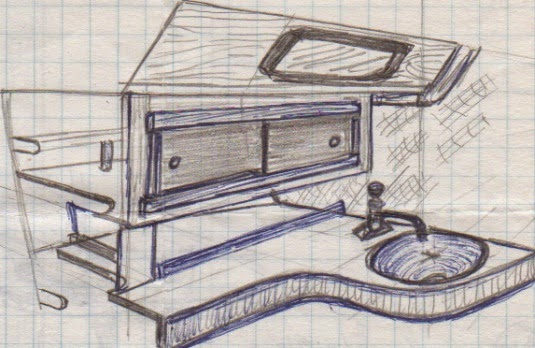
The original head compartment, shown to the left below, consisted of the head and small, fold-down sink (picture is from a sister ship). This picture shows the toilet located more forward than the one in our boat (see the “after” picture). We had an idea that the compartment was large enough to fit the sink in the space between the toilet and the forward bulkhead and to provide a storage compartment outboard and above the sink. On the right, below, is the concept sketch.


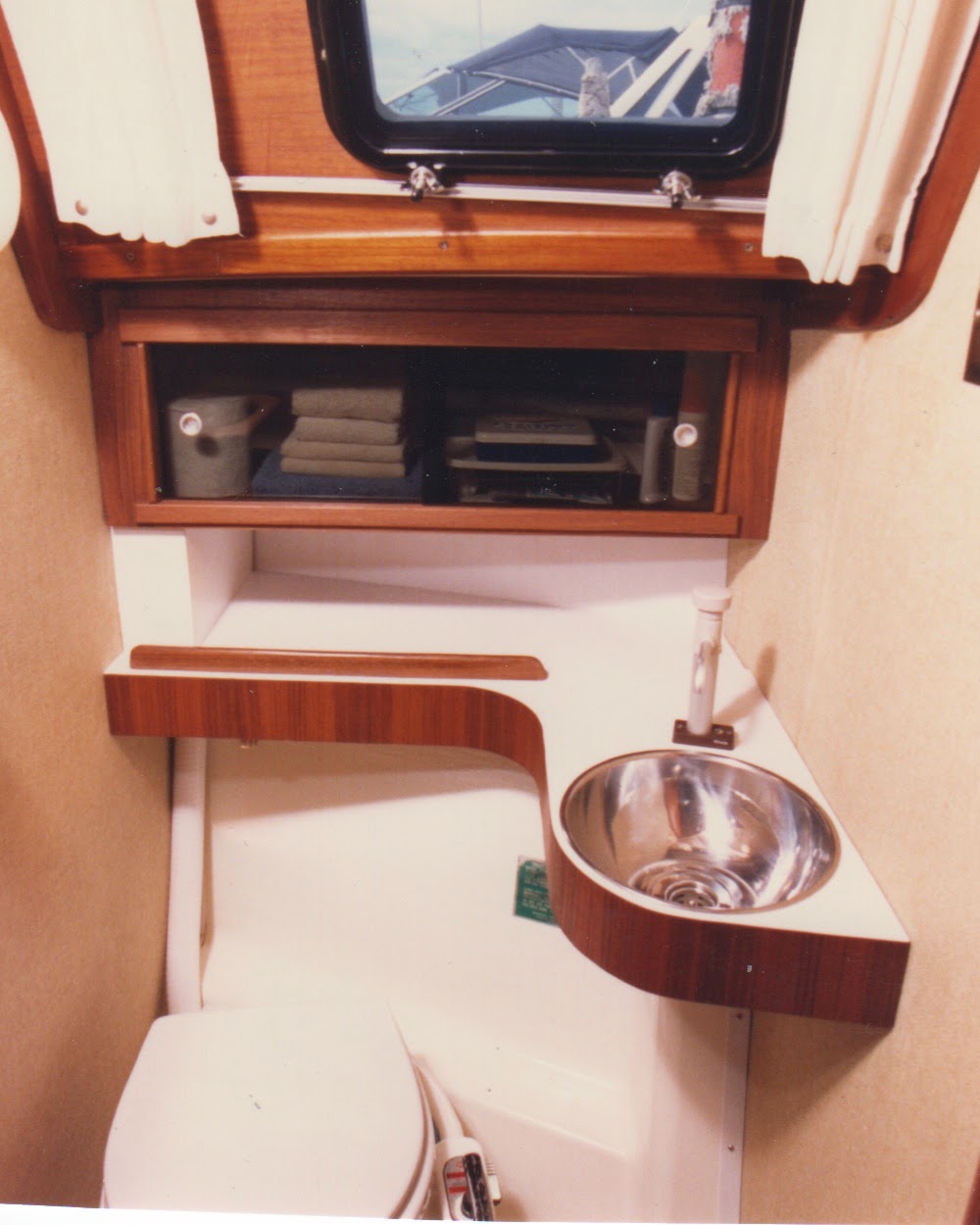
We removed the old cabinet and sink. (left-hand picture, below, looking directly outboard) The project involved many measurements, mockups, detail design and hours of fabrication before it was complete. The right-hand picture, below, shows the installation of the sink counter. The center lower picture,  below, shows the installation of the storage compartment.


This is the picture the completed installation.


The tan vinyl wall covering was replaced with thinner, vertical grade, white Formica in 1994.
The sink plumbing includes a ball valve in the inlet to the hand pump. This valve is normally closed to prevent fresh water from the tank from pouring out the hand pump when the boat is heavily heeled to port. There is also a ball valve in the sink drain line to maintain suction for the inlet side of the toilet flush pump. This is because the sink drain and the the toilet pump inlet share the same thru hull connection.

{Lessons learned:
  1. You should take the effort to use all available space in a small boat
  2. It helps to have a good knowledge of plumbing for boats.}